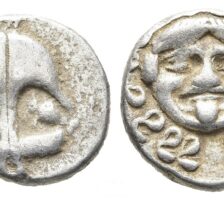
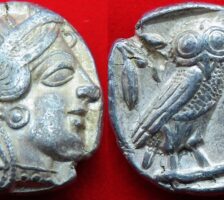
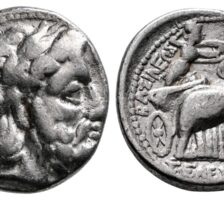
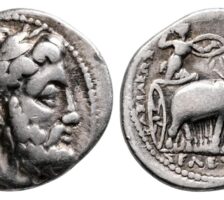
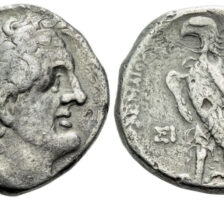
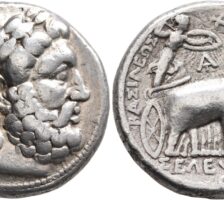
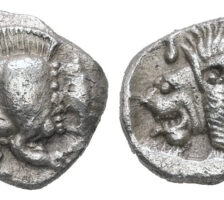
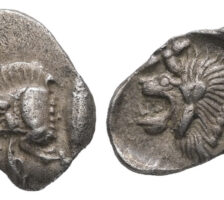
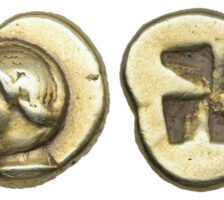
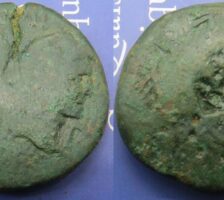
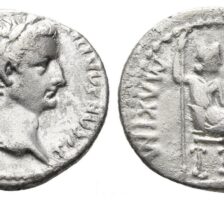
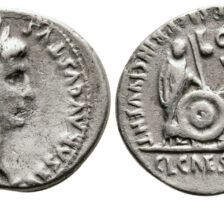
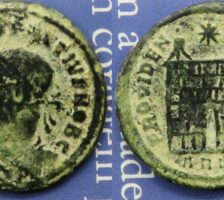
Very Rare! Mysia, Kyzikos.EL Hekte, 2.65 g 11.86 mm

Jafet Numismática - Loja de Moedas Antigas Colecionáveis


A Jafet Numismática é uma loja online de moedas clássicas antigas dedicada a proporcionar realização a colecionadores e numismatas que buscam peças autênticas, de alto padrão e valor para suas coleções.

Aqui você encontra um vasto acervo, assim como informações de interesse de todo apaixonado pela numismática clássica.

Romanas

Ver todas
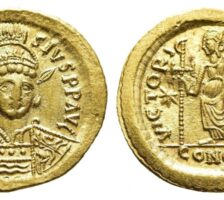
ANASTASIUS I (491-518). GOLD Solidus. Constantinople.  Obv: D N ANASTASIVS P P AVG. Helmeted and cuirassed bust facing slightly right, holding spear and shield decorated with horseman motif. Rev: VICTORIA AVGGG Θ / CONOB. Victory standing left, holding long staff surmounted by reversed staurogram; star to left.  MIBE 7; DOC 7i; Sear 5.  Anastasius was nicknamed ‘dikoros’ (=two pupils) because of the different color of his eyes. When Zeno died, since he had no living heirs, his widow Ariadne had the difficult choice of appointing a successor to the people, who demanded an orthodox emperor. Ariadne eventually chose Anastasius, about whom we only know that he was a palace official, responsible for maintaining silence during important sacred ceremonies. After Zeno's funeral, Anastasius received the crown from the patriarch, was acclaimed augustus by the crowd in 491, and married Ariadne to legitimize the succession. His main task was to restore Constantinople's finances, which had been severely affected during his predecessor's reign. He managed to balance the budget despite a policy of tax relief, making the people pay less tax, but in cash rather than in kind. This favored the cities but was to the detriment of the people living in the countryside, and in fact many revolts broke out in rural areas. He also revolutionized the tax collection system by introducing the ‘vindices’ and encouraged the return of copper folles, which began to circulate again with a precise value ratio to the gold solidus. Anastasius demonstrated wisdom and competence, and the Byzantine Empire flourished once again. A great amount of money flowed into the state treasury, which favored the work of his successors, particularly Justinian I. With regard to foreign policy, Anastasius reached an agreement with Theodoric, king of the Roman-Barbarian kingdom in Italy, promoting trade that benefited both kingdoms. Despite his undeniable qualities as an administrator, Anastasius was constantly threatened by intrigues and uprisings. He was also engaged in a long war against the Persians (502-506), which ended with a peace treaty and the construction of the Anastasian Wall to defend Constantinople along the Propontis and the Black Sea. However, the internal situation was more delicate. The emperor was not orthodox, as the people had asked Ariadne, but a convinced Monophysite, and he attracted much dissent, partly because he contributed to distancing the Eastern Church from that of Rome by interfering in the nomination of the new pope. The discontent led to a civil war (513-515) with the insurrection of Vitalian at the head of the Isaurians, who was eventually defeated by the general Marinus of Syria. Anastasius died in 518 at the age of almost ninety, but left no children to succeed him to the throne.  Condition: Near extremely fine.  Weight: 4.49 g. Diameter: 21 mm.

ANASTASIUS I (491-518). GOLD Solidus. Constantinople. Obv: D N ANASTASIVS P P AVG. Helmeted and cuirassed bust facing slightly right, holding spear and shield decorated with horseman motif. Rev: VICTORIA AVGGG Θ / CONOB. Victory standing left, holding long staff surmounted by reversed staurogram; star to left. MIBE 7; DOC 7i; Sear 5. Anastasius was nicknamed ‘dikoros’ (=two pupils) because of the different color of his eyes. When Zeno died, since he had no living heirs, his widow Ariadne had the difficult choice of appointing a successor to the people, who demanded an orthodox emperor. Ariadne eventually chose Anastasius, about whom we only know that he was a palace official, responsible for maintaining silence during important sacred ceremonies. After Zeno’s funeral, Anastasius received the crown from the patriarch, was acclaimed augustus by the crowd in 491, and married Ariadne to legitimize the succession. His main task was to restore Constantinople’s finances, which had been severely affected during his predecessor’s reign. He managed to balance the budget despite a policy of tax relief, making the people pay less tax, but in cash rather than in kind. This favored the cities but was to the detriment of the people living in the countryside, and in fact many revolts broke out in rural areas. He also revolutionized the tax collection system by introducing the ‘vindices’ and encouraged the return of copper folles, which began to circulate again with a precise value ratio to the gold solidus. Anastasius demonstrated wisdom and competence, and the Byzantine Empire flourished once again. A great amount of money flowed into the state treasury, which favored the work of his successors, particularly Justinian I. With regard to foreign policy, Anastasius reached an agreement with Theodoric, king of the Roman-Barbarian kingdom in Italy, promoting trade that benefited both kingdoms. Despite his undeniable qualities as an administrator, Anastasius was constantly threatened by intrigues and uprisings. He was also engaged in a long war against the Persians (502-506), which ended with a peace treaty and the construction of the Anastasian Wall to defend Constantinople along the Propontis and the Black Sea. However, the internal situation was more delicate. The emperor was not orthodox, as the people had asked Ariadne, but a convinced Monophysite, and he attracted much dissent, partly because he contributed to distancing the Eastern Church from that of Rome by interfering in the nomination of the new pope. The discontent led to a civil war (513-515) with the insurrection of Vitalian at the head of the Isaurians, who was eventually defeated by the general Marinus of Syria. Anastasius died in 518 at the age of almost ninety, but left no children to succeed him to the throne. Condition: Near extremely fine. Weight: 4.49 g. Diameter: 21 mm.

R$ 24.500,00

Novidades

Ver todas
ANASTASIUS I (491-518). GOLD Solidus. Constantinople.  Obv: D N ANASTASIVS P P AVG. Helmeted and cuirassed bust facing slightly right, holding spear and shield decorated with horseman motif. Rev: VICTORIA AVGGG Θ / CONOB. Victory standing left, holding long staff surmounted by reversed staurogram; star to left.  MIBE 7; DOC 7i; Sear 5.  Anastasius was nicknamed ‘dikoros’ (=two pupils) because of the different color of his eyes. When Zeno died, since he had no living heirs, his widow Ariadne had the difficult choice of appointing a successor to the people, who demanded an orthodox emperor. Ariadne eventually chose Anastasius, about whom we only know that he was a palace official, responsible for maintaining silence during important sacred ceremonies. After Zeno's funeral, Anastasius received the crown from the patriarch, was acclaimed augustus by the crowd in 491, and married Ariadne to legitimize the succession. His main task was to restore Constantinople's finances, which had been severely affected during his predecessor's reign. He managed to balance the budget despite a policy of tax relief, making the people pay less tax, but in cash rather than in kind. This favored the cities but was to the detriment of the people living in the countryside, and in fact many revolts broke out in rural areas. He also revolutionized the tax collection system by introducing the ‘vindices’ and encouraged the return of copper folles, which began to circulate again with a precise value ratio to the gold solidus. Anastasius demonstrated wisdom and competence, and the Byzantine Empire flourished once again. A great amount of money flowed into the state treasury, which favored the work of his successors, particularly Justinian I. With regard to foreign policy, Anastasius reached an agreement with Theodoric, king of the Roman-Barbarian kingdom in Italy, promoting trade that benefited both kingdoms. Despite his undeniable qualities as an administrator, Anastasius was constantly threatened by intrigues and uprisings. He was also engaged in a long war against the Persians (502-506), which ended with a peace treaty and the construction of the Anastasian Wall to defend Constantinople along the Propontis and the Black Sea. However, the internal situation was more delicate. The emperor was not orthodox, as the people had asked Ariadne, but a convinced Monophysite, and he attracted much dissent, partly because he contributed to distancing the Eastern Church from that of Rome by interfering in the nomination of the new pope. The discontent led to a civil war (513-515) with the insurrection of Vitalian at the head of the Isaurians, who was eventually defeated by the general Marinus of Syria. Anastasius died in 518 at the age of almost ninety, but left no children to succeed him to the throne.  Condition: Near extremely fine.  Weight: 4.49 g. Diameter: 21 mm.

ANASTASIUS I (491-518). GOLD Solidus. Constantinople. Obv: D N ANASTASIVS P P AVG. Helmeted and cuirassed bust facing slightly right, holding spear and shield decorated with horseman motif. Rev: VICTORIA AVGGG Θ / CONOB. Victory standing left, holding long staff surmounted by reversed staurogram; star to left. MIBE 7; DOC 7i; Sear 5. Anastasius was nicknamed ‘dikoros’ (=two pupils) because of the different color of his eyes. When Zeno died, since he had no living heirs, his widow Ariadne had the difficult choice of appointing a successor to the people, who demanded an orthodox emperor. Ariadne eventually chose Anastasius, about whom we only know that he was a palace official, responsible for maintaining silence during important sacred ceremonies. After Zeno’s funeral, Anastasius received the crown from the patriarch, was acclaimed augustus by the crowd in 491, and married Ariadne to legitimize the succession. His main task was to restore Constantinople’s finances, which had been severely affected during his predecessor’s reign. He managed to balance the budget despite a policy of tax relief, making the people pay less tax, but in cash rather than in kind. This favored the cities but was to the detriment of the people living in the countryside, and in fact many revolts broke out in rural areas. He also revolutionized the tax collection system by introducing the ‘vindices’ and encouraged the return of copper folles, which began to circulate again with a precise value ratio to the gold solidus. Anastasius demonstrated wisdom and competence, and the Byzantine Empire flourished once again. A great amount of money flowed into the state treasury, which favored the work of his successors, particularly Justinian I. With regard to foreign policy, Anastasius reached an agreement with Theodoric, king of the Roman-Barbarian kingdom in Italy, promoting trade that benefited both kingdoms. Despite his undeniable qualities as an administrator, Anastasius was constantly threatened by intrigues and uprisings. He was also engaged in a long war against the Persians (502-506), which ended with a peace treaty and the construction of the Anastasian Wall to defend Constantinople along the Propontis and the Black Sea. However, the internal situation was more delicate. The emperor was not orthodox, as the people had asked Ariadne, but a convinced Monophysite, and he attracted much dissent, partly because he contributed to distancing the Eastern Church from that of Rome by interfering in the nomination of the new pope. The discontent led to a civil war (513-515) with the insurrection of Vitalian at the head of the Isaurians, who was eventually defeated by the general Marinus of Syria. Anastasius died in 518 at the age of almost ninety, but left no children to succeed him to the throne. Condition: Near extremely fine. Weight: 4.49 g. Diameter: 21 mm.

R$ 24.500,00
Ver Todas as Categorias

Depoimento de Clientes

“Adorei as moedas. Tive um atendimento nota 1000! E exemplar pelo Dr Jafet tanto por e-mail como por telefone em contato comigo. A qualidade das moedas romanas é fantástico! Envelope da loja ricamente embalado. Gostei muito do Certificado com certos detalhes das moedas relacionados. Gostaria de dar uma sugestão: No verso do certificado se existe a possibilidade do Sr, no caso moedas com a éfige de Imperadores Romanos, um pequeno texto contendo dados históricos do Imperador em questão: Período de governo, Feitos políticos, o Império na sua época, campanhas militares que participou e seu Impacto no governo do Império. Obrigado. Ricardo Lanes”


Ricardo *** *** 21/07/2024

“A minha encomenda chegou direitinho, bem embalado e adorei os certificados das moedas muito lindos e bem feitos, muito obrigado pelo excelente atendimento, eu super recomendo o Jafet Numismática para todos.”


Carlos *** *** *** 03/12/2024

“Foi uma ótima experiência a aquisição de peças com a Jafet Numismática. Além de esclarecerem dúvidas sobre a curadoria das moedas, também são ágeis no envio após a compra. Muita segurança e confiabilidade foram passadas através da experiência com eles. Estou começando uma pequena coleção e o acervo da Jafet é um ótimo parceiro para ampliá-la, com certeza!”


Victor *** *** *** 20/09/2025

“Simplesmente incrível Moeda veio em um ótimo estado de conservação, com certificado Além de que a entrega foi muito rápida, chegou em apenas uma semana Bem confiável, pretendo comprar novamente no futuro”


Felipe *** *** *** *** 01/10/2024

“Recebi minha moeda da antiga cidade de Birytis, comprada na Jafet Numismática, e fiquei extremamente satisfeito com a qualidade da peça e o atendimento. A moeda apresenta uma pátina natural bem preservada, detalhes visíveis da cunhagem e está conforme descrito no anúncio. O certificado de autenticidade também foi um diferencial importante, reforçando a legitimidade da moeda.Além disso, a embalagem foi muito bem feita, garantindo que a peça chegasse em perfeitas condições. Recomendo a Jafet Numismática para colecionadores que buscam peças raras e autênticas. Com certeza voltarei a comprar!”


Sandiego *** 12/02/2025

“Envio e entrega realizada rapidamente, com produtos certificados e de altíssima qualidade e confiança.”


Arthur *** 03/09/2025